Industry Insights
How do you take contactless donations?
Cash giving is falling and it isn't coming back. This guide covers the practical side: the hardware, the offline behaviour that catches people out, and the tax relief trade-off nobody mentions.
By Nishchay Sachdeva · · 8 min read
Cash giving is falling, and it isn't coming back. If your fundraising still depends on a bucket, a plate or a collection box, you're collecting from a shrinking group of people who happen to have change on them.
The fix is well established by now. What gets far less attention is the practical side: what hardware you actually need, how it behaves without a signal, what it does to your reporting, and where tax relief gets complicated.
This is a working guide for organisations collecting across more than one location.
Key takeaways
- Contactless giving is now mainstream in Irish fundraising rather than an experiment, and large multi-site rollouts have been running for years.
- The main formats are fixed unattended terminals, staff-operated mobile terminals and QR codes. Most organisations end up using more than one.
- Offline operation is the detail that catches people out. Devices store transactions, but banks decline them if they aren't uploaded promptly.
- Fixed-amount buttons raise the average donation, while a custom amount option matters for the minority who want to give more.
- Tax relief usually depends on knowing who the donor is, and anonymous contactless giving doesn't capture that. It's the biggest operational trade-off.
The formats, and what each is for
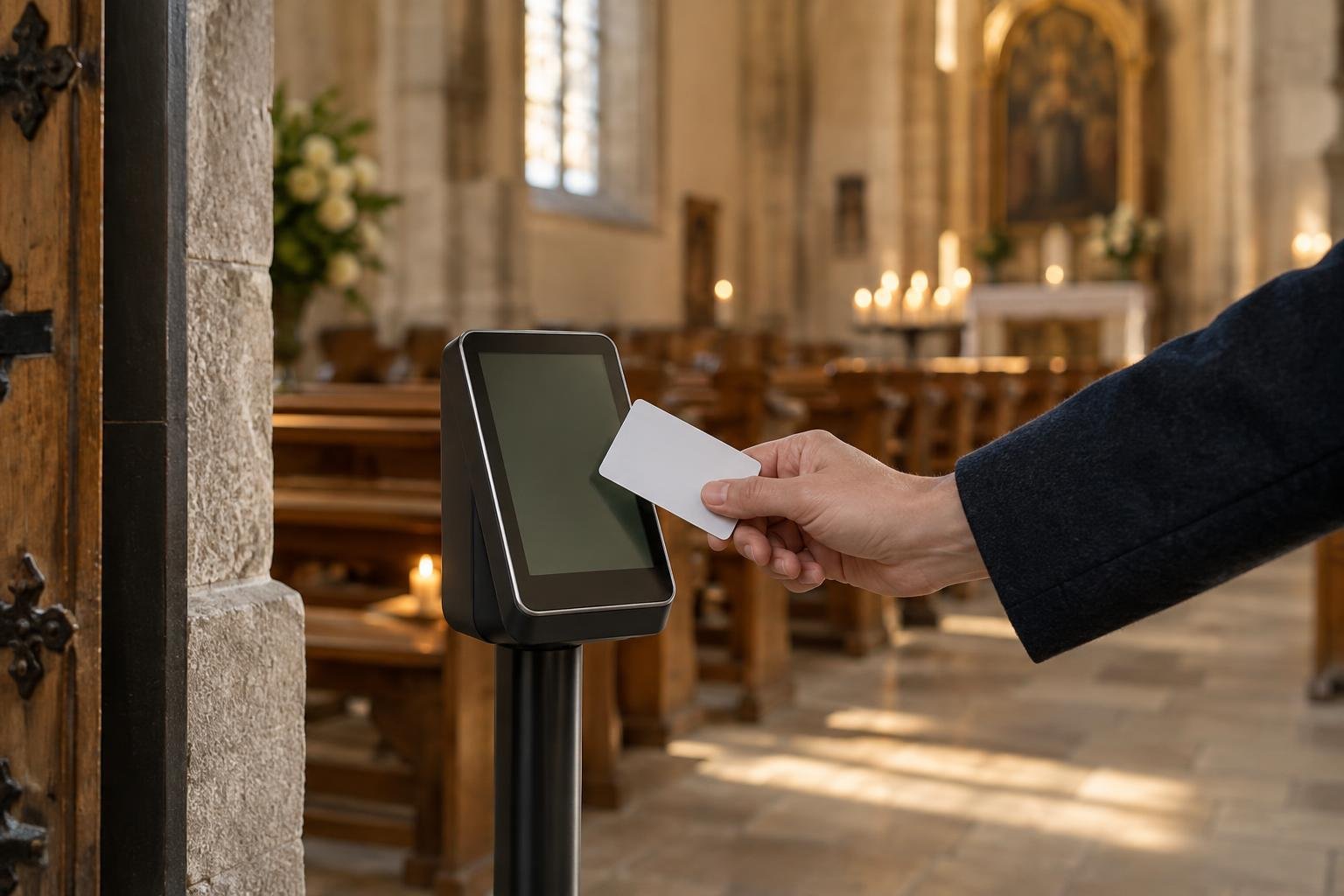
Fixed unattended terminals are mounted at an entrance, in a foyer or beside an exhibit. The donor taps and walks on, and nobody has to staff them. They suit high-footfall locations with predictable traffic, which is why they're the format used at scale in parishes and museums.
Staff or volunteer mobile terminals are usually a smart terminal carried at events, on the street or at collections. Someone enters or selects an amount and the donor taps. Because a conversation happens first, they're better for engagement and for higher-value gifts.
QR codes need no hardware at all. The donor scans and completes the donation on their own phone. They're the cheapest option to deploy and have the highest drop-off, but they're also the only route that reliably captures donor details, which matters for tax relief.
Most organisations of any size use a combination: fixed devices where footfall is steady, mobile devices for events, and QR as a fallback and for anyone who wants to give more than a tap allows.
What the Irish market looks like
This isn't early-adopter territory. The Archdiocese of Dublin began rolling out tap-to-donate terminals at church doors during the pandemic, with its general manager describing the plan to extend to all 197 parishes. Donors could choose from a range of fixed amounts or enter their own.
Our own work with the Archdiocese covers tap-to-donate and digital collection across more than 200 parishes. That's the multi-site version of the problem: not one device but hundreds, each needing to work unattended and report into one place.
The wider context is why it matters. Contactless fundraising providers point to projections that cash will account for only around a fifth of transactions, which makes cash-only collection a structural decline rather than a soft patch.
The operational details nobody mentions
This is where most guides stop, and where the real work starts.
Offline behaviour is the big one. Devices can store donations taken without a signal, but not indefinitely. The RNLI's volunteer guidance on contactless units is explicit: banks will decline transactions that aren't uploaded promptly, and the recommendation is to offload stored transactions within 24 hours. It also advises against leaving a device in an area of poor signal for long periods.
If you fundraise in rural areas, at outdoor events or in stone buildings with poor reception, build the upload step into your volunteer routine. Otherwise you'll lose donations you think you've collected.
Repeat taps trip people up too. The same guidance notes that a donor who wants to give more can tap again, but needs to leave roughly a minute between taps. Volunteers who don't know this tend to report the device as faulty.
Devices can also be configured with a maximum donation. Whether you want one depends on your risk appetite and the setting.
Then there's the choice between preset amounts and a keypad. Buttons such as €2, €5 and €10 reduce hesitation and raise the average gift, because the donor is choosing rather than deciding. A minority of donors want to give substantially more, though, and if the device can't accommodate that, you're capping your most generous supporters. Offer both.
The tax relief problem
This is the genuinely difficult part, where anonymous contactless giving and tax efficiency pull against each other.
Contactless donations taken on an unattended terminal are anonymous by design. There's no name, no email and no address, which is exactly what makes them frictionless, and exactly what makes them ineligible for schemes that require donor identification.
In Ireland, the Charitable Donation Scheme allows approved bodies to claim a refund on qualifying donations, but it operates on an annual threshold per donor and requires the donor to be identified and to have made a declaration. A stream of anonymous €5 taps doesn't qualify, however large it becomes in aggregate.
The UK position differs and is worth knowing if you operate in both. The Gift Aid Small Donations Scheme covers eligible small donations, and platforms note that Gift Aid is claimable on eligible contactless small donations up to £30, with larger or non-anonymous donations routed through a QR code to a form on the donor's own device.
The practical implication is the same in both jurisdictions. Give donors who want to be identified a route to do it, such as a QR code alongside the terminal, a follow-up flow or a regular giving sign-up, rather than treating anonymous tapping as the whole programme. You'll still collect the spontaneous small gifts, and you'll capture the relationships that lead to larger, reclaimable giving.
Thresholds and scheme rules change, so confirm your position against current Revenue guidance or with your own adviser rather than relying on a blog post.
Reporting across many locations
For a single device, reconciliation is trivial. For two hundred, it's the whole job.
At scale, the hard questions are which locations are performing, which devices have stopped transacting, what the average gift is by site, when donations actually happen, and whether the total that reached the bank matches the total collected.
Cash collection answers none of these. Arguably that's the bigger benefit of going contactless: not the extra donations, but finally having a record. Every donation is timestamped, attributed to a location and reconciled automatically, so fundraising performance becomes something you can manage rather than estimate.
This is what our donations solution is built around, and it's why unified reporting matters more for a multi-site charity than for almost anyone else. A parish, a shop, an event and an online appeal can all report into the same view. With Cost Centres, that view can then be split by parish, region or campaign, so each part of the organisation sees its own numbers while the total stays in one place.
Where to start
- Work out where your footfall actually is. Fixed devices belong where people already pause, and mobile devices where conversations happen.
- Decide your preset amounts, and make sure a custom amount is still possible.
- Write the offload routine into your volunteer instructions before the first event, not after a batch of declines.
- Build an identified giving route alongside the anonymous one, so tax relief stays available.
- Ask how reporting works across locations before you commit. It's the difference between buying a device and running a programme.
If you're collecting across multiple sites and want to talk through a rollout, we work with charities, parishes and non-profits across Ireland and the UK, and we're happy to have that conversation.
Frequently asked questions
What equipment do I need to take contactless donations?
There are three options, often used together: a fixed unattended terminal for high-footfall locations, a staff-operated mobile terminal for events and street collections, and a QR code that needs no hardware at all. Which you need depends on whether donations happen at a fixed point or wherever your fundraisers are.
Do contactless donation devices work without an internet connection?
They can store transactions taken offline, but not indefinitely. Banks decline transactions that aren't uploaded promptly, and guidance generally recommends offloading within 24 hours. Leaving a device in an area of poor signal for long periods risks losing donations you think you've taken.
Can donors give more than the preset amounts?
Yes, if the device is configured for it. Most units offer preset buttons plus a keypad for a custom amount. Some also let a donor tap more than once, usually with around a minute between taps. Preset amounts raise the average gift, so it's worth offering both rather than choosing.
Can I claim tax relief on contactless donations?
It depends on donor identification. Anonymous contactless donations generally don't qualify for schemes that require a donor declaration and an annual threshold, such as Ireland's Charitable Donation Scheme. The UK's Gift Aid Small Donations Scheme has different provisions for eligible small donations. The practical answer is to offer an identified giving route alongside the anonymous one, and to confirm current rules with Revenue or your adviser.
How do I reconcile donations across many locations?
Through a platform that reports centrally rather than device by device. At scale, questions such as which locations perform, which devices have stopped working and what the average gift is by site can only be answered if every donation is timestamped and attributed to a location automatically.
Will contactless replace cash donations entirely?
Not immediately, and there's no reason to force it. Some donors will keep giving cash, particularly older supporters. The realistic position is contactless as the main route, with cash accepted alongside it, on the understanding that the cash share will keep declining.
#contactless donations #charity #parish giving #tap to donate #fundraising #non-profit
Keep reading
More from the Facilipay blog · Customer case studies · Talk to our team